Simulate a random walk as series of equal-length steps with turning angles
drawn from a normal distribution.
Usage
crw(
  theta = c(0, 5),
  stepLen = 10,
  initPos = c(0, 0),
  initHeading = 0,
  nsteps = 10000
)
Arguments
- theta
A 2-element numeric vector with turn angle parameters
(theta[1] = mean; theta[2] = sd) from normal distribution.
- stepLen
A numeric scalar with total distance moved in each step.
- initPos
A 2-element numeric vector with nital position (initPos[1]=x,
initPos[2]=y).
- initHeading
A numeric scalar with initial heading in degrees.
- nsteps
A numeric scalar with number of steps to simulate.
Value
A two-column data frame containing:
- x
x coordinates
- y
y coordinates
Details
First, nsteps turn angles are drawn from a normal distribution. Second, the
cumulative sum of the vector of turn angles defines the heading within each
step. The x and y component vectors in each are then calculated and summed
to obtain the simualted path.
Note
Adapted from code provided by Tom Binder.
Author
C. Holbrook (cholbrook@glfc.org)
Examples
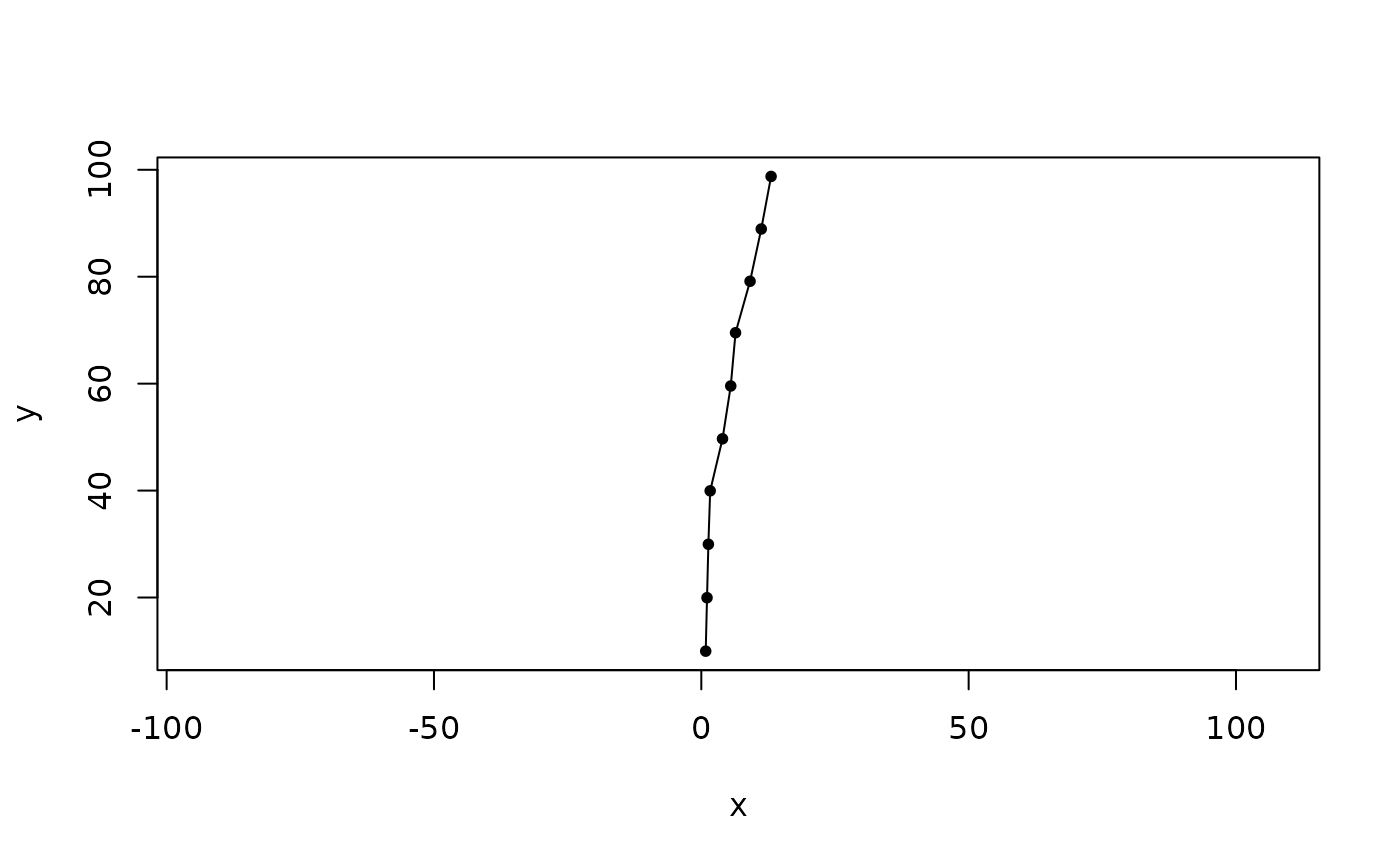
foo <- crw(
  theta = c(0, 5), stepLen = 10, initPos = c(0, 0), initHeading = 0,
  nsteps = 10
)
plot(foo, type = "o", pch = 20, asp = c(1, 1))